Introduction to Machine Learning
A beginner-friendly guide to understanding what Machine Learning is, how it works, and how to get started.
Table of Contents
- What is Machine Learning?
- Why Machine Learning Matters
- Types of Machine Learning
- Key Concepts & Terminology
- The Machine Learning Workflow
- Common Algorithms
- How Models Are Evaluated
- Tools and Libraries
- Real-World Applications
- Challenges and Limitations
- Roadmap for Beginners
- Resources to Learn More
What is Machine Learning?
Machine Learning (ML) is a subset of Artificial Intelligence (AI) that enables computers to learn from data without being explicitly programmed for every task.
Traditional Programming: Data + Program -> Output Machine Learning: Data + Output -> Program (Model) that can predict future outputs
In simple terms, instead of writing rules, we show the machine thousands of examples and it learns the pattern.
Why Machine Learning Matters
- Handles complex data: Can find patterns in data too large or complex for humans
- Automates decisions: From spam filtering to fraud detection
- Powers modern products: Recommendation systems (Netflix, YouTube), voice assistants, self-driving cars, ChatGPT
- Improves with data: The more data it sees, the better it generally gets
Types of Machine Learning
1. Supervised Learning
The model learns from labeled data. You give it inputs (X) and correct outputs (y).
- Classification: Predict a category. Example: Email -> Spam / Not Spam
- Regression: Predict a number. Example: House size -> Price
Most common type in industry.
2. Unsupervised Learning
The model finds hidden patterns in unlabeled data.
- Clustering: Group similar data points. Example: Customer segmentation
- Dimensionality Reduction: Simplify data. Example: PCA, t-SNE
3. Reinforcement Learning
An agent learns by interacting with an environment, getting rewards or penalties.
- Example: AlphaGo learning to play Go, robots learning to walk
4. Other Types
- Semi-Supervised: Mix of labeled + unlabeled data
- Self-Supervised: Creates its own labels from data (basis for Large Language Models)
Key Concepts & Terminology
- Dataset: Collection of examples
- Feature: Input variable (e.g., age, height, pixel values)
- Label: What you want to predict
- Model: Mathematical function that maps features to predictions
- Training: Process of learning from data
- Loss Function: Measures how wrong the model is
- Overfitting: Model memorizes training data, fails on new data
- Underfitting: Model is too simple to capture the pattern
- Train / Validation / Test Split: 60-80% for training, 10-20% for validation (tuning), 10-20% for final testing
- Bias-Variance Tradeoff: Balance between simplicity and flexibility
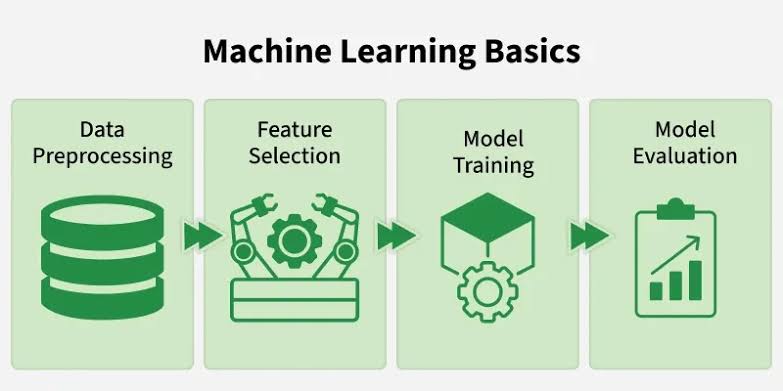
The Machine Learning Workflow
- Define Problem: What are you trying to predict?
- Collect Data: Gather relevant, quality data
- Clean & Prepare Data: Handle missing values, outliers, normalize
- Exploratory Data Analysis (EDA): Visualize and understand data
- Feature Engineering: Select and create better features
- Choose a Model: Start simple (Linear Regression, Logistic Regression)
- Train the Model: Fit model on training data
- Evaluate: Test on validation/test data
- Tune Hyperparameters: Improve performance (Grid Search, Random Search)
- Deploy & Monitor: Put into production and watch for data drift
Common Algorithms
| Task Type | Algorithm | When to Use | | :--- | :--- | :--- | | Regression | Linear Regression | Simple, interpretable baseline | | Classification | Logistic Regression | Binary classification baseline | | Classification | K-Nearest Neighbors (KNN) | Small datasets, intuitive | | Both | Decision Trees | Easy to visualize and explain | | Both | Random Forest | Robust, handles many features | | Both | Gradient Boosting (XGBoost, LightGBM) | Often wins competitions | | Both | Support Vector Machines (SVM) | Works well with high dimensions | | Unsupervised | K-Means Clustering | Customer segmentation | | Deep Learning | Neural Networks | Images, text, audio, large data |
How Models Are Evaluated
For Classification:
- Accuracy, Precision, Recall, F1-Score
- Confusion Matrix
- ROC-AUC Score
For Regression:
- Mean Absolute Error (MAE)
- Mean Squared Error (MSE)
- R-squared
Golden Rule: Never evaluate on the same data you trained on. Always use unseen test data.
Tools and Libraries
Programming Language: Python is the standard.
Core Libraries:
NumPy,Pandas- Data manipulationMatplotlib,Seaborn- Data visualizationScikit-learn- The go-to for classical MLTensorFlow/PyTorch- For Deep LearningKeras- High-level Deep Learning API
Platforms:
- Jupyter Notebook / Google Colab (for experimenting)
- Kaggle (datasets and competitions)
Real-World Applications
- Healthcare: Disease prediction from scans
- Finance: Fraud detection, credit scoring
- Retail: Recommendation engines
- Transportation: Self-driving cars, route optimization
- NLP: Chatbots, translation, sentiment analysis
- Computer Vision: Face recognition, object detection
Challenges and Limitations
- Needs lots of high-quality data
- Biased data = Biased model
- Black-box models are hard to interpret
- Requires computational resources
- Ethical concerns: privacy, job displacement
Roadmap for Beginners
Week 1-2: Python basics + Pandas + NumPy Week 3-4: Learn Supervised Learning - Linear/Logistic Regression, Decision Trees Week 5: Practice on a dataset (e.g., Titanic, Iris, House Prices on Kaggle) Week 6: Learn Model Evaluation and Overfitting/Underfitting Week 7-8: Try Random Forest, XGBoost and Unsupervised Learning Month 3+: Dive into Deep Learning and build a project
Tip: Learn by building. Pick one small project and finish it end-to-end.
Resources to Learn More
- Course: Andrew Ng - Machine Learning Specialization (Coursera)
- Book: Hands-On Machine Learning with Scikit-Learn & TensorFlow - Aurélien Géron
- Practice: Kaggle.com - Learn section + Competitions
- Visualization: Google's Teachable Machine
- YouTube: StatQuest, 3Blue1Brown (Neural Networks)
Simple Code Example (Python)
# A simple classifier with scikit-learn
from sklearn.datasets import load_iris
from sklearn.model_selection import train_test_split
from sklearn.ensemble import RandomForestClassifier
from sklearn.metrics import accuracy_score

# 1. Load data
data = load_iris()
X, y = data.data, data.target

# 2. Split data
X_train, X_test, y_train, y_test = train_test_split(X, y, test_size=0.2, random_state=42)

# 3. Choose and train model
model = RandomForestClassifier()
model.fit(X_train, y_train)

# 4. Predict and evaluate
predictions = model.predict(X_test)
print(f"Accuracy: {accuracy_score(y_test, predictions) * 100:.2f}%")
Author: Sithija Mudalige License: Free to use and share Version: 1.0 - September 2026